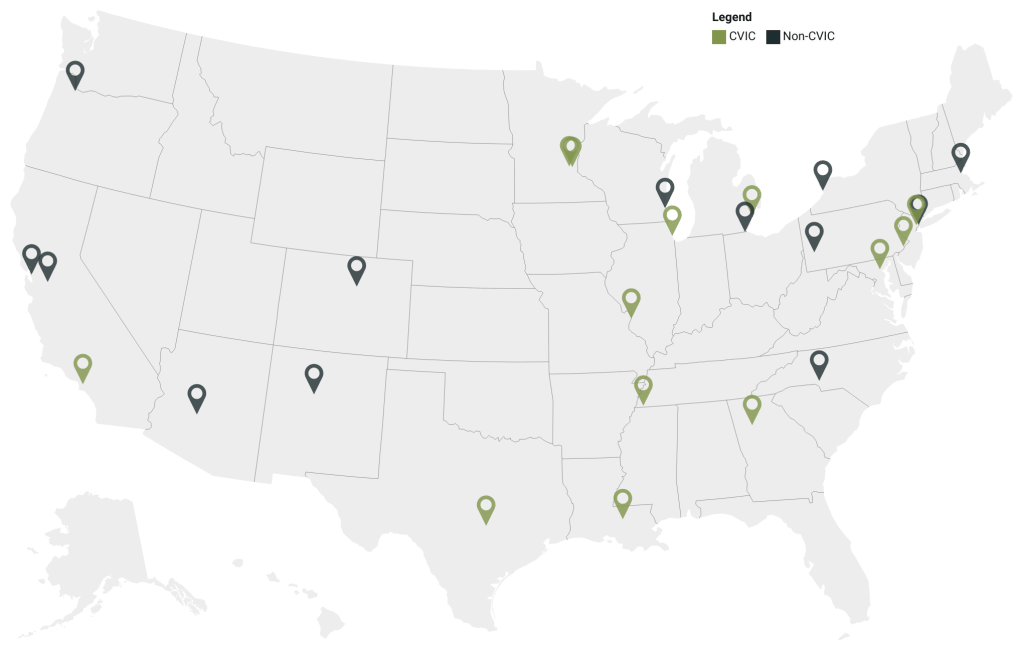
This project examines how governments in the United States are spending their American Rescue Plan Act (ARPA) funds and how ARPA is affecting city governments’ investments in Community Violence Interventions (CVIs). We investigate this topic by looking at both macro-level spending patterns and case studies of 26 large, metropolitan cities.
- Albuquerque, New Mexico
- Atlanta, Georgia
- Austin, Texas
- Baltimore, Maryland
- Baton Rouge, Louisiana
- Boston, Massachusetts
- Buffalo, New York
- Charlotte, North Carolina
- Chicago, Illinois
- Denver, Colorado
- Detroit, Michigan
- Jersey City, New Jersey
- Los Angeles, California
- Memphis, Tennessee
- Milwaukee, Wisconsin
- Minneapolis, Minnesota
- Newark, New Jersey
- Oakland, California
- Philadelphia, Pennsylvania
- Phoenix, Arizona
- Pittsburgh, Pennsylvania
- Portland, Oregon
- St. Louis, Missouri
- St. Paul, Minnesota
- Stockton, California
- Toledo, Ohio
Thirteen of these case cities, indicated in green on the map above, are currently part of the White House Community Violence Intervention Collaborative, a cohort of jurisdictions committed to scaling “evidence-based community-led strategies to reduce gun violence and enhance public safety.” The other half, indicated in gray on the map above, are pair cities with similar characteristics to those within the CVIC.
Available Datasets
CVI Projects
This dataset contains a list of all SLFRF-funded projects for all state and local governments that have been categorized by each government as community violence intervention. Each record includes a project classification assigned by researchers (CVI / CVP, victim services, law enforcement, courts, other, unclear), the project description and name, as well as the adopted budget and cumulative expenditures over time.
Methodology
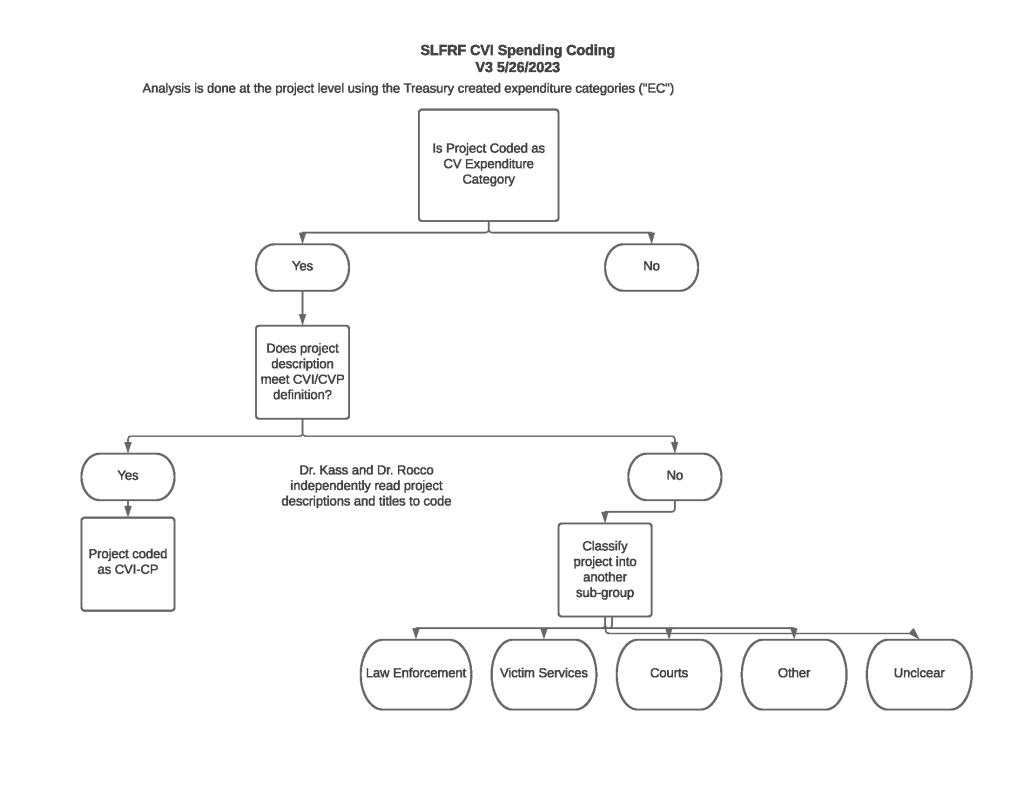
Each government that receives SLFRF dollars must submit quarterly reports to the Treasury Department detailing how they are budgeting and spending those funds. With each new report, the project team evaluates whether projects categorized by the submitting government as community violence intervention meet one of the following definitions:
- Community violence intervention (CVI): A project that invests in community-driven strategies that involve at-risk populations to reduce the incidence of violence (in particular gun violence) and in an alternative to traditional policing. The goal of these programs is to disrupt cycles of violence within a community. These strategies could include: (a) group violence interventions; (b) community-based violence interrupters; and/or (c) hospital-based interruption programs. Well-known programs include CURE Violence (formally known as CeaseFire) in Chicago, Caught in the Crossfire in Los Angeles, Safe Streets in Baltimore, and Violence Intervention Advocacy Program at Boston Medical Center and Massachusetts General Hospital.
- Community violence prevention (CVP): A broader range of interventions that aim at addressing root causes of violence and the government is explicitly employing to reduce community violence. This could include treatments such as Trauma-Focused Cognitive Behavior Therapy ®(TF-CBT) and Multisystemic Therapy®, strengthening economic supports through job training or summer youth job programs, connecting youth to caring adults and activities such as mentoring and after-school programs, as well as general income support programs.
Projects that meet at least one of the above definitions are coded as CVI-CVP. Projects that do not meet the project team’s definition of CVI-CVP are assigned to one of the following additional codes:
| Code | Description |
| Courts | Anything related to the sentencing or punishment of crime that has already taken place. For example, a diversion program. |
| Law Enforcement | Encompasses all spending tied to police departments, sheriff offices, surveillance equipment (like Ring cameras), and programs tied to school shootings. |
| Victim Services | These are programs and services for victims of crime, which can include domestic violence and child abuse. |
| Other | These are for projects that have a clear and defined program or service, but do not fall into one of the other categories. |
| Unclear | These are for projects that have a vague or incomplete project description. For example, one project description is simply “To Be Determined.” |
The diagram below illustrates this evaluation process.
 How are cities spending ARPA funds to address violent crime